Why Won’t My Kid Do Homework??

Among my clients past and present, one of the biggest issues seems to be homework. Not just for younger kids – this extends from the elementary grades, all the way through college.

It would be difficult to find a kid who LIKES homework (excluding fun projects). But ADHD kiddos in particular seem to have an aversion to assignments that outmatches their neurotypical peers. Why is that?

  • Lack of dopamine – completing homework generally does not give someone a major dopamine boost. In ADHDers, whose dopamine is already compromised, this makes doing homework less attractive than…well, almost anything. Homework is boring!
  • Reward system differences/time blindnesskids with ADHD don’t respond to negative consequences as a motivator. This means that telling your child “if you don’t do your homework you will fail the class” doesn’t have the impact it would have on a neurotypical child. Furthermore, due to time management executive function challenges, using a future impact to convince an ADHD child to do their work is ineffective. ADHDers tend to have two time periods: now, and some other time. And some other time is vague and not really a factor.
  • Additional work due to incomplete class assignments – ADHD kiddos, whether due to lack of focus, lack of interest, or not attending to/understanding directions, can have difficulty completing classwork during the class period.They may then be tasked with completing the work at home. This is not given instead of homework; it is added to the homework load. So ADHD kids can, on any given night, have double the workload of neurotypical children.
  • Challenges with planning and organization many kids – and adults – with ADHD lack the ability to plan and organize their assignments. This is due to executive function weaknesses, including non-verbal working memory challenges. So when your child comes home, all they see is this massive mountain called Homework, which they find intimidating. Avoidance is a natural response to this.
  • Not knowing what they need to do – with my clients, I have found that every teacher has their own way of disseminating information. Some use Google Classroom. Some expect students to copy homework assignments from the board, into their planners. Some yell out, at the end of class, “do the problems on page 9 for homework!” This inconsistency is anathema to a child that already has issues with organization. 

So yes, there are real reasons relating to your child’s ADHD for being less than thrilled about homework. But homework exists anyway. What can we do?

Here are some strategies to try with your ADHD kiddo, gleaned from my years as both a teacher, and an ADHD coach:

1 – Speak to the child’s teacher(s) – if your child is struggling with getting their homework done in a reasonable amount of time, or if your family’s wellbeing is being challenged by nightly homework battles, your first stop is the teacher. There is no way for the teacher to know what goes on after school without someone telling them. If your child is older, they can have a conversation with the teacher. Advocating for themselves is a life skill they will need as they get older.

2 – Help your child plan out their homework – Every day, have an adult (you or someone else) sit down with your child to develop a plan for getting their assignments done. This means going through Google Classroom (if being used), notebooks, and planners to see what has been assigned and when it is due. Be sure to ask your child if they have any additional classwork to finish up. If your child is older, it is still important for them to complete this planning stage. Perhaps emailing it to you is a good way to have accountability without your direct participation.


3 – For larger assignments, help your child plan out the steps to completion – This includes determining what actions are necessary (so, rather than putting “book cover” on your list, include a verb like “draw book cover”), and creating deadlines for each step. Again, having your older child do this and emailing it to you works well. This is basically outsourcing non-verbal working memory.

4 – Designate a space for your child to do their homework – This does not have to be a desk in their room; in fact, being away from everyone may lead to turning to other, more dopamine producing activities (aka videogames). Setting up at the kitchen table consistently can work, as long as there isn’t a ton of distractions and activity.

5 – No screens before or during homework – Many of us feel sorry for our kids, and want to let them have a little fun before going back to work. However, once they are on their phones or watching TV we have lost them, and the pull back to homework becomes substantially more painful. Screentime, in whatever form you choose, can be the reward for homework completion; it is not necessary or advisable before or during homework time.

6 – Try body doubling with your kid – Body doubling, an extremely successful ADHD strategy, involves working at the same time, in the same place (in person or virtually) as someone else, but not directly working with them. So, for example, sitting at the kitchen table while your kid does homework, you can be paying bills, doing your own work, or even just reading. It helps to keep both parties on track. You can do this with your college student on Zoom – bonus points for having contact with your kid!

There are many, many more strategies living in my ADHD Homework toolbox – these are just a few to get you started. Please reach out if you need more help!
 

My Prime Days Picks For ADHDers!

Prime Days are here! (July 16 and 17). Here are some products that I think are great for ADHDers and people with executive function struggles. Many are kid related – back to school is not too far away – but a few are for adults and/or kids. Happy Shopping!

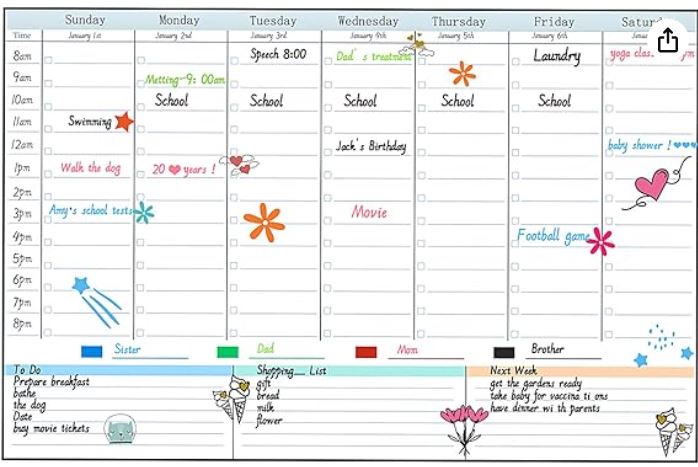
POPRUN Magnetic Weekly Dry Erase Calendar

What makes this particular dry erase calendar a favorite? I love that you can write in the times of day on the left side. This enables you, and your family, to see exactly how the day will look. Dentist from 3pm to 4pm? It’ll be blocked out. White space? Ah, that’s free time! Helping those with time blindness actually see time is such a benefit. https://amzn.to/4bLKFLe

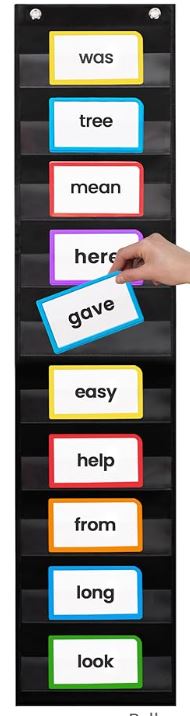
Essex Wares Classroom Pocket Chart

I’m harkening back to my teaching days to recommend this pocket chart. This is a great tool to use for morning or evening routineslist the steps (or better yet, take pictures of your child completing the steps), and when they finish each task, they can turn the card over. Kind of low tech, I know, but that tactile zing one gets when turning over that card is very satisfying! Adults can use it too, it’s great for tasks with a few or several steps that are completed (when we remember) over time – yes, laundry, I’m looking at you! https://amzn.to/3zKojwq

Storage Cubes with Windows and Hooks

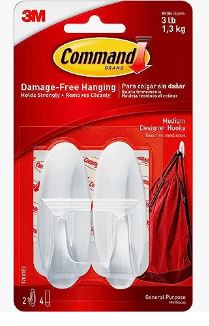
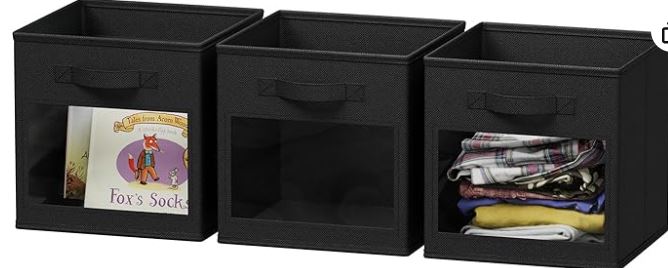
And speaking of laundry…it’s possibly the biggest challenge I come across the most with my clients. Hate doing it, hate starting it, can’t move clothes from washer to dryer….and the biggest issue, putting the clothes away. I’m a big believer in making the system work for you, not the other way around. So, two ideas: first, put hooks in your closet, and use them for items that you’d like hung up, but loathe the thought of putting them on hangers. And second, does everything need to be folded? Nope! Underwear, socks, maybe tee shirts and workout clothes, can all just be tossed into one of these fabulous storage cubes. The window lets you see what lives there. It also enables a heads up as to when you are running out of underwear.  https://amzn.to/4cIbAJp https://amzn.to/3LohhAb

Weewooday Cube 15-20-30-60 Flip Timer

A fun variation on the kitchen timer, this flip cube gives you four minute options. Just flip it to the time you want, and off it goes. Great for “Can I have 15 more minutes, Mom?” as well as “I need to leave in 30 minutes.” Comes in several colors, I just like the pink 🙂  https://amzn.to/4f5Tker

Kick Bands

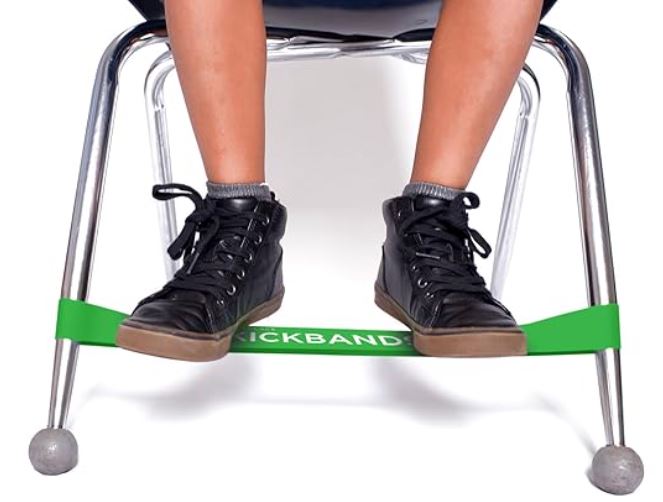
These bands are awesome for kids – and adults – who are more focused when they are performing some type of movement (studies have shown this to be an effective strategy for ADHDers). Simply place the band around the legs of any chair, and you’ve created a spot for quiet, unobtrusive foot bouncing. These have been used in classrooms for ages. Is it time to get some for homework time? Or meal times? https://amzn.to/3xPYb2O 

Blue Ginkgo Multipurpose Caddy Organizer

While it’s helpful for your child to have a specific area in which to do homework (or for you to have a home office that you can use consistently), there are times when a refresh can be helpful (she says as she types this in her husband’s office). Having the basic supplies in a caddy that can be carried easily makes that transition from the bedroom to the kitchen table quick and painless…with less time to get distracted. https://amzn.to/4d3lyVn

Paperage Lined Journal Notebook
Last but not least, a reasonably priced lined notebook. This can be used for…anything, really. A bullet journal, to do list, doodling space, gratitude journal, meeting notes. I have one that I use as a gratitude journal, and one that I use as my brain dump, a parking lot for everything in my head until I move it to my more actionable task app. Comes in tons of colors, the paper is smooth, and at this price, no guilt if you change up your task management plan. https://amzn.to/3xZg8f9 

What items do you find are indispensable? I’d love to hear from you!

Disclosure: I am an Amazon Associate, and have an affiliate relationship with Amazon.

Try These Ideas To Work On Your Child’s Executive Functions This Summer!

Over the last few weeks, I’ve heard from lots of parents who, upon reaching the end of the school year, want to see a different experience for their child-and for themselves-next year.

And chances are, they would like to see their child improve their executive functions.

The executive functions-there are several, although different researchers have different ideas on how many-are the parts of the brain that allow intentions to turn into actions. They can be divided into the “thinking functions,” such as time management and organization, and the “doing functions,” including task initiation and emotional control.

In ADHDers, the executive functions are impaired (although not necessarily all of them, or to the same degree). Additionally, research has shown that ADHD kiddos can be 2-3 years behind their neurotypical peers developmentally, which translates into a lag in the development of the executive functions.

Simply put, when it comes to the executive functions, your ADHD child struggles.

And not only does your kid feel that they are behind, or panic not knowing where or how to start their assignment, they also have to deal with the many-and I mean many-negative messages they get from teachers, coaches, other kids, siblings, and relatives, about their inability to just DO THE THING.

As a parent, I’ll raise my hand here, and say that I, too, said things like “You’re so much smarter than this,” or “Why do I have to tell you a million times??”

It can be downright upsetting.

But, there are ways to both help strengthen those pesky executive functions, and/or to accustom your child to various strategies that can support his weaker skills. And you don’t have to wait for homework or book reports! Here are a few:

1 – Assign chores.  Being given household jobs is a great way for your child  to feel that you trust them to be responsible, and that they are contributing to the upkeep of your home. However, for our ADHD friends, chores should be structured in a particular way. 

  • Saying “clean your room” really isn’t specific enough. Break the chore down to smaller tasks, and depending on your child’s age, consider giving them responsibility for some of the subtasks first, rather than the whole thing. 
  • Also, how often do you think this should take place? It is better to have small daily tasks than one large weekly job.
  • Set a time of day to accomplish these tasks, with an alarm (not you) announcing the time. This should take place BEFORE fun activities that are tough to pull away from.
  • Use this time to do a chore or two yourself. This is called “body doubling,” and seeing you also working can keep your child on track. 
  • Finally, profusely thank your child for helping with the household responsibilities. Consider rewards (small things, like a trip to the ice cream parlor, or a slurpee)-we all get paid for our jobs, why shouldn’t your child??

2 – Work together to plan a trip or outing. Deciding on a place to go, and then working together to identify, prioritize, and execute different tasks is a great way to not only practice using executive function skills, but to enable you and your child to see where the gaps are, and what kind of support might be helpful. For example, if one of the tasks is to map out the trip on Google Maps, and your child has forgotten to do it, setting a reminder might help-and might stick in your child’s brain as a way to remember tasks.

3 – Keep a family calendar. Time blindness is very common for ADHDers (kids and adults). Putting events and responsibilities on a calendar makes it easier for your ADHD kiddo to see time. It will also help with transitions, as the events of the day are readily available.

4 – Allow for unstructured time – WITHOUT electronics. When your child has free time to play ball, read, draw, run around the woods-whatever they like to do-they are flexing their executive function muscles. Putting together Legos takes attention, organization, working memory, and emotional control. Pretending requires flexibility, attention, and non-verbal working memory. And the best thing about play is that, for the most part, you are not involved. They are strengthening their EF skills, and having fun, all on their own.

5 – Play board games. Family board game nights are so much fun! And without even realizing it, your child will be getting executive function training. Following directions, waiting their turn, developing a game plan-all of these involve the executive functions. And it’s such a wonderful way to spend time together.

This is just a sampling of activities that will help your child to put their executive functions to work, and learn what kind of support is helpful, all at a low pressure time of year. Give one or two a try!