Why Won’t My Kid Do Homework??

Among my clients past and present, one of the biggest issues seems to be homework. Not just for younger kids – this extends from the elementary grades, all the way through college.

It would be difficult to find a kid who LIKES homework (excluding fun projects). But ADHD kiddos in particular seem to have an aversion to assignments that outmatches their neurotypical peers. Why is that?

  • Lack of dopamine – completing homework generally does not give someone a major dopamine boost. In ADHDers, whose dopamine is already compromised, this makes doing homework less attractive than…well, almost anything. Homework is boring!
  • Reward system differences/time blindnesskids with ADHD don’t respond to negative consequences as a motivator. This means that telling your child “if you don’t do your homework you will fail the class” doesn’t have the impact it would have on a neurotypical child. Furthermore, due to time management executive function challenges, using a future impact to convince an ADHD child to do their work is ineffective. ADHDers tend to have two time periods: now, and some other time. And some other time is vague and not really a factor.
  • Additional work due to incomplete class assignments – ADHD kiddos, whether due to lack of focus, lack of interest, or not attending to/understanding directions, can have difficulty completing classwork during the class period.They may then be tasked with completing the work at home. This is not given instead of homework; it is added to the homework load. So ADHD kids can, on any given night, have double the workload of neurotypical children.
  • Challenges with planning and organization many kids – and adults – with ADHD lack the ability to plan and organize their assignments. This is due to executive function weaknesses, including non-verbal working memory challenges. So when your child comes home, all they see is this massive mountain called Homework, which they find intimidating. Avoidance is a natural response to this.
  • Not knowing what they need to do – with my clients, I have found that every teacher has their own way of disseminating information. Some use Google Classroom. Some expect students to copy homework assignments from the board, into their planners. Some yell out, at the end of class, “do the problems on page 9 for homework!” This inconsistency is anathema to a child that already has issues with organization. 

So yes, there are real reasons relating to your child’s ADHD for being less than thrilled about homework. But homework exists anyway. What can we do?

Here are some strategies to try with your ADHD kiddo, gleaned from my years as both a teacher, and an ADHD coach:

1 – Speak to the child’s teacher(s) – if your child is struggling with getting their homework done in a reasonable amount of time, or if your family’s wellbeing is being challenged by nightly homework battles, your first stop is the teacher. There is no way for the teacher to know what goes on after school without someone telling them. If your child is older, they can have a conversation with the teacher. Advocating for themselves is a life skill they will need as they get older.

2 – Help your child plan out their homework – Every day, have an adult (you or someone else) sit down with your child to develop a plan for getting their assignments done. This means going through Google Classroom (if being used), notebooks, and planners to see what has been assigned and when it is due. Be sure to ask your child if they have any additional classwork to finish up. If your child is older, it is still important for them to complete this planning stage. Perhaps emailing it to you is a good way to have accountability without your direct participation.


3 – For larger assignments, help your child plan out the steps to completion – This includes determining what actions are necessary (so, rather than putting “book cover” on your list, include a verb like “draw book cover”), and creating deadlines for each step. Again, having your older child do this and emailing it to you works well. This is basically outsourcing non-verbal working memory.

4 – Designate a space for your child to do their homework – This does not have to be a desk in their room; in fact, being away from everyone may lead to turning to other, more dopamine producing activities (aka videogames). Setting up at the kitchen table consistently can work, as long as there isn’t a ton of distractions and activity.

5 – No screens before or during homework – Many of us feel sorry for our kids, and want to let them have a little fun before going back to work. However, once they are on their phones or watching TV we have lost them, and the pull back to homework becomes substantially more painful. Screentime, in whatever form you choose, can be the reward for homework completion; it is not necessary or advisable before or during homework time.

6 – Try body doubling with your kid – Body doubling, an extremely successful ADHD strategy, involves working at the same time, in the same place (in person or virtually) as someone else, but not directly working with them. So, for example, sitting at the kitchen table while your kid does homework, you can be paying bills, doing your own work, or even just reading. It helps to keep both parties on track. You can do this with your college student on Zoom – bonus points for having contact with your kid!

There are many, many more strategies living in my ADHD Homework toolbox – these are just a few to get you started. Please reach out if you need more help!
 

If You Don’t Know The Basic Science Behind ADHD, You Need to Learn It

When I do an initial intake with a new client, one of the questions I ask is “What would you like to learn about your ADHD?”  It’s a pretty broad question, and most responses center around wanting to learn how to be more productive, or how to organize their lives.

At that point, I ask, “How much do you know about the brain science behind your ADHD?”

The majority say they don’t know anything, or very little. The word dopamine is bandied about a bit. And most surprisingly, when I ask if they would like to know more, most say, “I don’t really need to.”

Oh, but you do. You really, really do.

I’m not talking about becoming a neuropsychologist, or obtaining the knowledge that your psychiatrist has. But having a basic understanding of what physically makes your brain different, and how that impacts your life, is, in my opinion, essential. 

First, it is vital to understand that there are physical differences between the ADHD brain and the neurotypical brain. It is not being lazy, or dumb, or anything behavioral. Comprehending that concept opens up an entire world for those of you who have been chastising yourselves about not trying harder. Or just not getting over it.

Would you berate yourself because you haven’t tried harder to see better, if you are a glasses wearer? Of course not. And just because this is a brain related disorder does not make it any less physical.

Repeat that to yourself a few times.

Secondly, I’m not sure how one can make a well informed decision about symptom management if they don’t understand what is causing the symptoms to begin with.

Let’s take an example from my running life. Let’s say I have a pain in my knee. In order to decide how to handle that, (Rest? Ice? New running shoes? Surgery?) I need to understand what may have happened that resulted in this pain before I can decide what I need to do next.

With ADHD, having a working comprehension of what is causing symptoms can help us to make solid treatment decisions. Knowing that my brain has lower dopamine might lead me to use medication to offset that. Understanding that the areas of my brain that control my emotional responses are different than those belonging to neurotypicals might convince me to try meditation to help with regulating my responses.

Deciding on one’s symptom management without having a basic understanding of what is causing the symptoms is like wearing a bikini on a sunny day…in February. You just don’t have all the facts to make an informed decision.

Finally, having a basic working knowledge of how your brain is different enables you to set up your life in ways that support you.

Dopamine low? Let’s make things more fun to get us going! Executive functions negatively impacted? Maybe an accountability buddy or group can help keep us on track. Fight or flight activated quickly? Perhaps I need to let my significant other know this can happen.

I don’t mean to imply that the ADHD brain is wrong, or broken, or just not effective. Not at all. But it IS different. And providing yourself with that knowledge is a gift of self awareness, and part of the ADHD toolbox for living your best life.

How Body Doubling Is Changing My Life!

That sounds awfully dramatic, doesn’t it? But it’s the truth!

I have a project that has been sitting on my back burner for so long, it’s blending in with the decor. It’s a terrific project, a great idea, something that, if I can get it off the ground,will enable me to help people make major positive changes in their lives…

But, there it sits.

And the thing is, I already started it, awhile back. So it’s not about starting this project, and feeling overwhelmed. It’s about starting AGAIN.

It’s that same feeling you get when you’ve been going to the gym consistently, and then life happens, and you miss one workout, and another, and another. It’s almost harder to go BACK to the gym than it was to start in the first place.

What’s up with that?

When we are starting something new, there’s excitement. There’s anticipation. Using the gym example, there are so many possibilities-feeling great, looking chiseled, meeting new people.

But that excitement isn’t really there when we go BACK to something we’ve done in the recent past. Sure, we know it’s a good idea, we looked and felt much better when we were working out often, but it’s really hard to drum up that “new” feeling that kicks our enthusiasm-and our dopamine-up several notches.

And that’s exactly what I have run into with my project. I know it’s a great idea, but I also can’t garner that “Yahoo!” feeling. The newness isn’t there. Plus I also know about the downside-that I actually have to do work to make it happen!

Enter body doubling. Body doubling is when we work alongside someone, as opposed to with them. It is a great way to keep working-you’re not going to start playing on your phone when you’ve committed to working and your body double can see you. So it works fantastically well for distractions.

But as an incentive to start a task? Yup!

A friend offered to body double with me while I work on this project. She had some work to do as well, so we would both benefit.

And suddenly, the newness was there! I was going to work with my friend! And be able to share my progress! 

This new twist made all the difference.

So far, we’ve body doubled once, and now, I’m working away on my project even when she’s not around, so I can tell her how far I’ve come since I saw her last. Accountability is built into the process, along with having a work buddy.

Now, there is actually hope of completing this project in the foreseeable future, which could really be a game changer for me, and others. 

The project is off the back burner. In fact-it’s got a hell of a fire under it. Thanks to body doubling.

If you are interested in body doubling with me, you can register for my weekly Monday afternoon sessions-FREE! Here’s the link:  https://calendly.com/constellationadhdcoach/body-doubling

ADHD Books That I Love!

As promised, here is a list of some of my favorite ADHD books, just in time for Prime Days on July 11 and 12. Here we go!

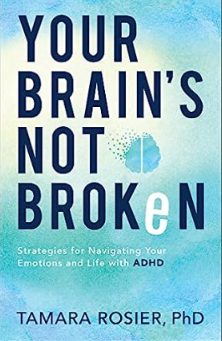
Your Brain’s Not BrokenTamara Rosier

If you are only going to buy one book from my recommendations, this would be the one I would say is a must. I have been fortunate enough to attend a few webinars held by Tamara Rosier, so I was excited to read her book-and it did not disappoint! Your Brain’s Not Broken has user-friendly explanations of ADHD brain differences, including examples. Additionally, the strategies presented, which take the emotional dysregulation ADHDers can experience fully into account, are explained so well that they can be put into action quickly and easily.

What I love about this book: I love everything about Your Brain’s Not Broken! First of all, the notion of motivation being determined by emotions is so thought provoking; it makes so much sense, but this is the first time I’m seeing it spelled out so clearly. Also, Rosier’s presentation of different clients, and her own ADHD, makes this book so relatable. I couldn’t put it down! https://amzn.to/3NF0YzH

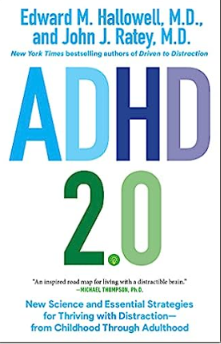
ADHD 2.0 – Edward M. Hallowell and John J. Ratey

Dr. Hallowell could be called one of the Grand Poobahs of ADHD research, treatment, and writing. ADHD 2.0 is an update to Hallowell’s original book, Driven to Distraction, which was (and still is) the ADHD bible. ADHD 2.0, in addition to explaining the brain science behind ADHD, also discusses different ways to enable ADHDers to thrive (such as exercise and connecting with others).

What I love about this book:  Dr. Hallowell’s approach is strengths based, meaning that rather than focus on what one has difficulty with, ADHDers are encouraged to lean on what they are great at. Dr. Hallowell is such a positive force in ADHD treatment, and that shines through in ADHD 2.0. https://amzn.to/44EculN

how to keep house while drowningKC Davis

This book, and the YouTube and TikTok videos that KC Davis has created, are legendary among ADHDers. Ms. Davis has developed Struggle Care, a very basic plan for keeping your house in some form of order, based on the (very true) concept that having a messy house is not a moral failure, it is simply a functional challenge. how to keep house while drowning has suggestions for housekeeping that take into account ADHD, depression, anxiety, postpartum…basically, life. You can use the 31 day plan that is presented, or just read through and choose what you’d like to work on.

What I love about this book:  Throughout how to keep house while drowning, one feels like you are sitting and schmoozing with a friend who is telling you that it’s all going to be okay, and that you’re being too hard on yourself. It’s a comforting little booklet. https://amzn.to/46EJfAY

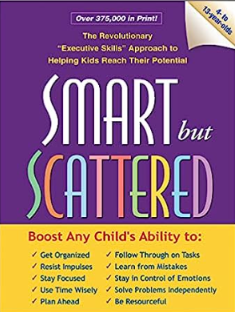
Smart But ScatteredPeg Dawson and Richard Guare

Smart But Scattered is a great book for parents who are looking for practical advice on how to help their ADHD child work with their challenged executive functions. There is a terrific explanation of what the executive functions are, with examples. A section on general strategies to employ when dealing with your child follows. Finally, there are suggestions (with implementation plans) and examples relating to a variety of issues that any ADHD parent will recognize.

What I love about this book: The approach that is presented in Smart But Scattered towards working with your ADHD child is on point. Dawson and Guare tell parents to “modify tasks to match your child’s capacity to exert effort,” and “begin by changing things outside the child before…strategies that require the child to change.” In other words, work with your child, not against them. Doesn’t sound terribly profound…but it is. https://amzn.to/3O4zUuR

All Dogs Have ADHD – Kathy Hoopmann

All Dogs Have ADHD is a picture book full of dogs doing, well, dog things. But what makes this book special is that the pictures tell the story of ADHD. So, a dog jumping into a lake is “diving straight into a situation without thinking about the consequences.” You get the idea. This book is great for kids who have ADHD, and also those who don’t, but spend time around ADHDers. The photographs are beautiful, and the pups are adorable.

What I love about this book: Parents often want to sugarcoat for their kids. All Dogs Have ADHD doesn’t do that-while the book does end on a very positive note, the positives and negatives are given equal time. Also…dogs. Need I say more?? (PS-there is a companion book, All Cats Are On The Autism Spectrum) https://amzn.to/46RhntE

I could go on and on..but I’ll save some of my faves for another post down the road. Happy Reading!!

Disclosure: I am an Amazon associate, and have an affiliate relationship with Amazon.