The Emotional Cost of the ADHD Tax

The ADHD tax. Have you heard of it?

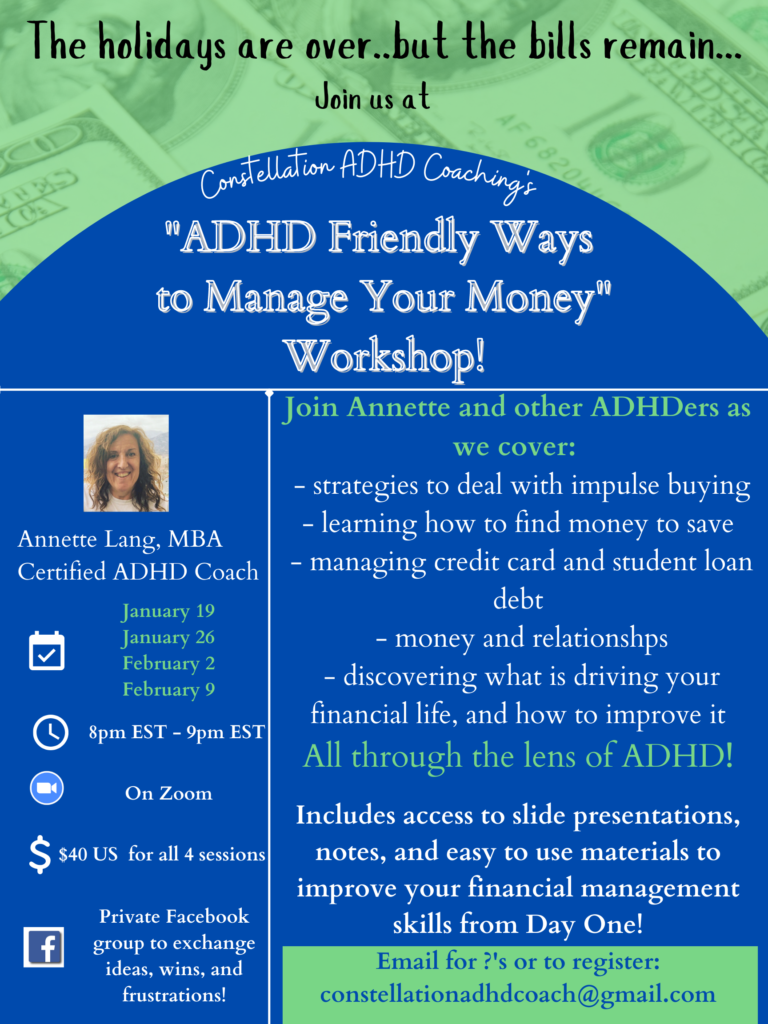
Due to executive function challenges, folks with ADHD can lack organizational skills, which can in turn cause them to forget to pay bills. Add time blindness to the mix – “Oh, that’s not due for ages! I’ll worry about it then!” – and working memory issues that impact planning actions, and you have a recipe for the additional costs for goods and services, including late fees and higher borrowing costs due to lowered credit scores, that is semi jokingly referred to as the ADHD tax.

There are other ADHD related factors that impact financial stability. These include impulsivity (buying without forethought), people pleasing (gifts one can’t afford, or purchases to help one fit in or impress), and of course, dopamine seeking (shopping can boost dopamine, tracking one’s money is boring). While these don’t directly lead to the ADHD tax, the less control one has over their money situation, the more apt they are to avoid dealing with it, leading to behaviors that cost us.

If the only impact of the ADHD tax was to our wallets, while it wouldn’t be great, we’d probably just chalk it up to another ADHD problem, like losing our keys or getting lost in a project, and pay the late fees. However, there is more to the ADHD tax than dollars and cents.

The emotional cost associated with feeling financially out of control – for which the ADHD tax is an indicator – can be quite large. According to a 2020 study, ““participants who had difficulty paying bills were more likely to have high levels of depressive symptoms and anxiety compared to those who did not have financial difficulty.”  Per a TIAA February 2024 report, 42% of U.S. adults say that money negatively impacts mental health.

Add ADHD to this witch’s cauldron of financial instability, and the emotional impacts increase. Per a study published by The Guardian, “…those with ADHD are twice as likely (76%) to suffer from anxiety linked to their finances compared with the general population (38%).” And even more alarming, according to a 2020 study by Beauchaine et al, “financial distress is associated with fourfold higher risk of suicide among those with ADHD.”

Suddenly the ADHD tax isn’t even remotely amusing.

You may have experienced the negative emotions that accompany the ADHD tax. Feelings of shame and embarrassment are common. One can feel hopeless – why can’t I manage to pay my bills on time like everyone else? And there can be guilt too, especially if others are impacted. These emotions can become cyclical: shame and guilt leading to avoidance of financial monitoring, or the classic “retail therapy” prescription, which can lead to more spending, which starts the cycle all over again.

So what is one to do about this?

There will be those who tell you “just use a budget app.” They may even tout an ADHD friendly budgeting system. However, that app, without any further accommodations and awareness, will sit on the shelf, gathering dust, while the emotional and monetary costs increase.

There are accommodations that can help autopay, an accountability buddy to keep you from avoiding the issue, dopamine boosting rewards (I’m a fan of the Money Meeting – complete with coffee and cookies – with myself, weekly). If there is avoidance happening, we can dip our toes in by just checking balances for a couple of weeks. If we can afford it, maybe a virtual bookkeeper would help.

But in order for any strategy to work, we need to understand what is driving our behavior. And we need to accept the differences in how ADHD brains work, so that we are willing to stop trying to manage our finances the neurotypical way.

And for this piece of advice…no charge.

I Wish I Had A River To Skate Away On..

It’s coming on Christmas,

They’re cutting down trees,

They’re putting up reindeer, singing songs of joy and peace,

Oh I wish I had a river I could skate away on.

Even Joni Mitchell felt overwhelmed by the holidays (btw, if you’ve never heard her holiday song “River,” go listen to it right now. You’re welcome).

“Overwhelmed? What do you mean? It’s the most wonderful time of the year!!”

Perhaps. But the holidays are a lot. And when you have ADHD, they are a lot of a lot.

For example, getting gifts for people can be so difficult. Analysis paralysis, plus people pleasing, plus lack of financial control, can become a nightmare scenario of buying at the last minute. Add the ADHD tax of having to send gifts via FedEx 24 hour delivery. And the possible future issue of buying gifts without actually knowing how much you can afford, and will have to pay for.

And then there is receiving gifts. “Now how could receiving gifts be a problem?” you say, thinking that I am some sort of Grinch. 

Let’s try a little scenario here.Your mom gets you a sweater. She gets your sister a bracelet. Probably the same monetary value, and you did ask for a sweater. BUT her gift is so much nicer! Mom loves her more! Rejection sensitivity skating on in! 

Or your mom gets you a sweater. But you didn’t ask for a sweater; you asked for gloves. Does your mom not think you know what you need? How can she ignore what you asked for? Let’s have a little emotional dysregulation with those gloves please!

And I cannot leave out the actual holiday celebration. Family, friends…what could go wrong??

If you are fortunate enough to celebrate with your people, your very own chosen tribe…enjoy every minute!

But many of us will be spending the holidays with family from near and far that are not quite so understanding of neurodivergence.  Some of that family may not be very well versed in ADHD – what it is, and what it isn’t. Unbelievably, there are still people who think ADHD is fake – all you, or your ADHD kiddos, need is a kick in the ass.

Getting through dinner with those who deny your issues, and who feel the need to let you know this, is what would send me through the door, looking for any sort of body of water to skate away on.

So, what is one to do? How can an ADHDer have a happy holiday season? Here are just a few tips.

1 – Recognize that the holidays are not necessarily all they are cracked up to be, to eliminate the feeling of FOMO, as well as the idea that you have failed at Christmas. Ignore Facebook and Instagram posts showing perfect trees, happy children, couples kissing under the mistletoe. Real life is not a Hallmark Christmas special! 

2 – For gift buying, if possible, try to figure out how much to spend in total. The more you spend on one person, the less you will have for someone else. This can keep the January regrets – and credit card bills – from ruining the start of 2026.

3 – A gift that someone gives to you is not a linear measure of how they feel about you. It’s a culmination of so many things – what they think you might like, sure, but also what is on sale? What comes in your size? What did they give you last year? How much do they have to spend on gifts? When you start to feel rejection sensitivity relating to a gift you are given, ask yourself if YOUR gifts reflect ONLY how you feel about someone? 

4 – It is okay, if you are feeling overwhelmed or irritated at any point during the holiday festivities, to excuse yourself from the area, and spend some time alone. Splash cold water on your face, take deep breaths, mentally sing a song. You don’t have to be at the table for every single minute of the day.

5 – Likewise, you do NOT have to go to every holiday event to which you are invited. There will be some that feel mandatory, and you may have to weigh the “price” of going versus the “price” of sitting it out. For example, the work Christmas party may be an event you feel you can’t miss. You do not, however, have to stay from start to finish! 

6 – Finally, and perhaps most importantly, give some thought to what YOU would like to have as part of your holiday. Is it binging “Gillmore Girls” while wearing PJ’s and eating ice cream? Do it. Is it Face Timing with your far away nieces and nephews? Do it. Is it making a yummy breakfast for your kids, and then letting them wear sweatpants to Grandma’s house for Christmas lunch, rather than fighting with them? Do it. You can invent your own traditions, or eschew last year’s plans to make new ones this year. Use that fabulous ADHD creativity to create the holiday YOU want.

Whatever makes you feel like you don’t want to skate away on that river…at least, not today.

The Holiday Gift of Letting Yourself Off the Hook

We are in the midst of the holiday season-which, by the way, seems to have started in September, but I digress-and with every gift we purchase, every party we attend, many of us can’t help just raining down criticism. On ourselves.

“They’re going to know I didn’t spend a lot. Why didn’t I save more for gifts? Why can’t I control my finances? What is wrong with me??

“If I could only get organized, I wouldn’t be shopping at the last minute. I’m just a mess!

“I can see that they hate my gift. If I could only pay attention better, I would’ve had a clearer idea of what to get them. They must think I just don’t care!

And on. And on. And on.

It’s not just ADHDers who have this anti-self patter reverberating in our brains-neurotypicals are prone to it as well, especially during high pressure moments. But for ADHDers, the negativity is often a way of life, with negative messages shooting like arrows at them since their youth.

How about giving yourself a little gift this holiday season? How about letting yourself off the hook?

When you start to think, “wow, I just suck,” how about a little self compassion? 

So you didn’t save more for gifts. Okay, maybe that’s something to work on. But the fact is-you’re giving gifts. Which is a really nice thing to do.

You’re shopping last minute. But hey-you’re getting some great markdowns!

They might not like your gift. But you did give something-again, very nice. Next time, maybe a gift card?

You get the idea.

And while you’re at it-maybe let your spouse, children, or parents off the hook, just for a bit.

It might be the best gift you ever give to them, or to yourself.

Merry Christmas, Happy Kwanzaa, and Happy 2024!!